Degenerative Knowledge Production
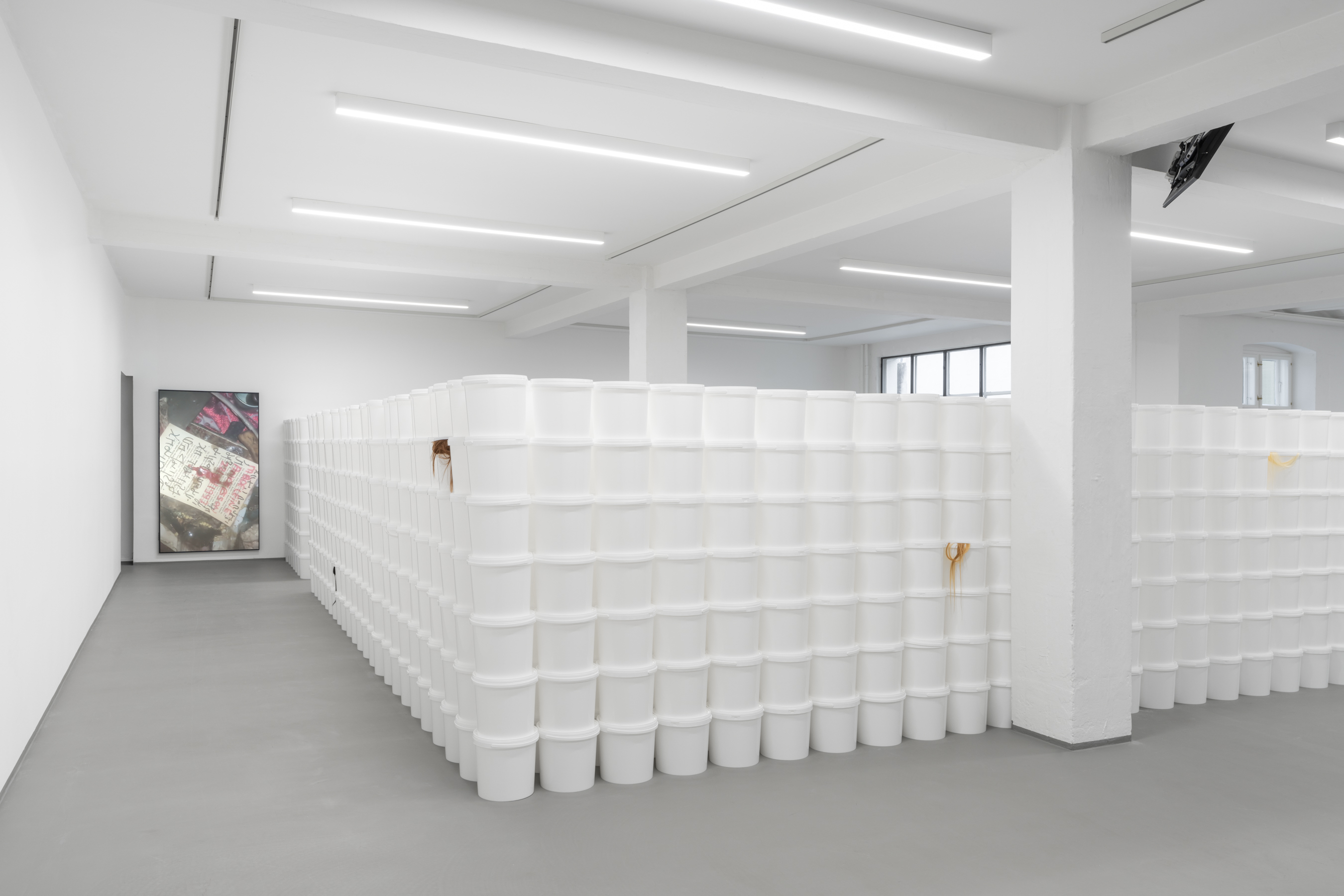
O–Overgaden, Copenhagen, 2024’10k Virgin Brains’ - Sculpture; buckets and hair
’My ordering a mind control spell of Etsy to be cast on myself’ - Video
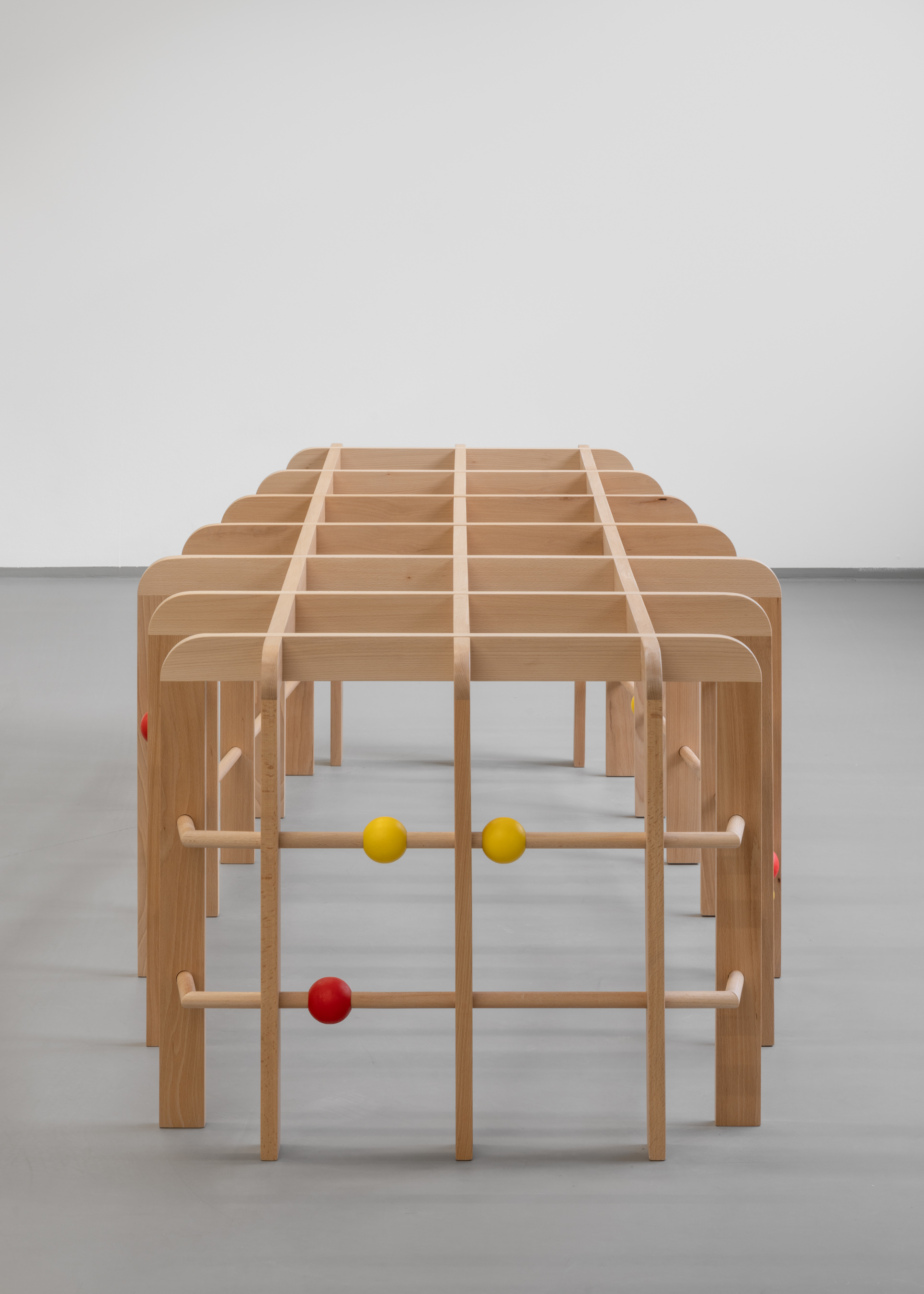
’Knock Knock’ - Sculpture; wood
’Bataille’s flies’ - Video
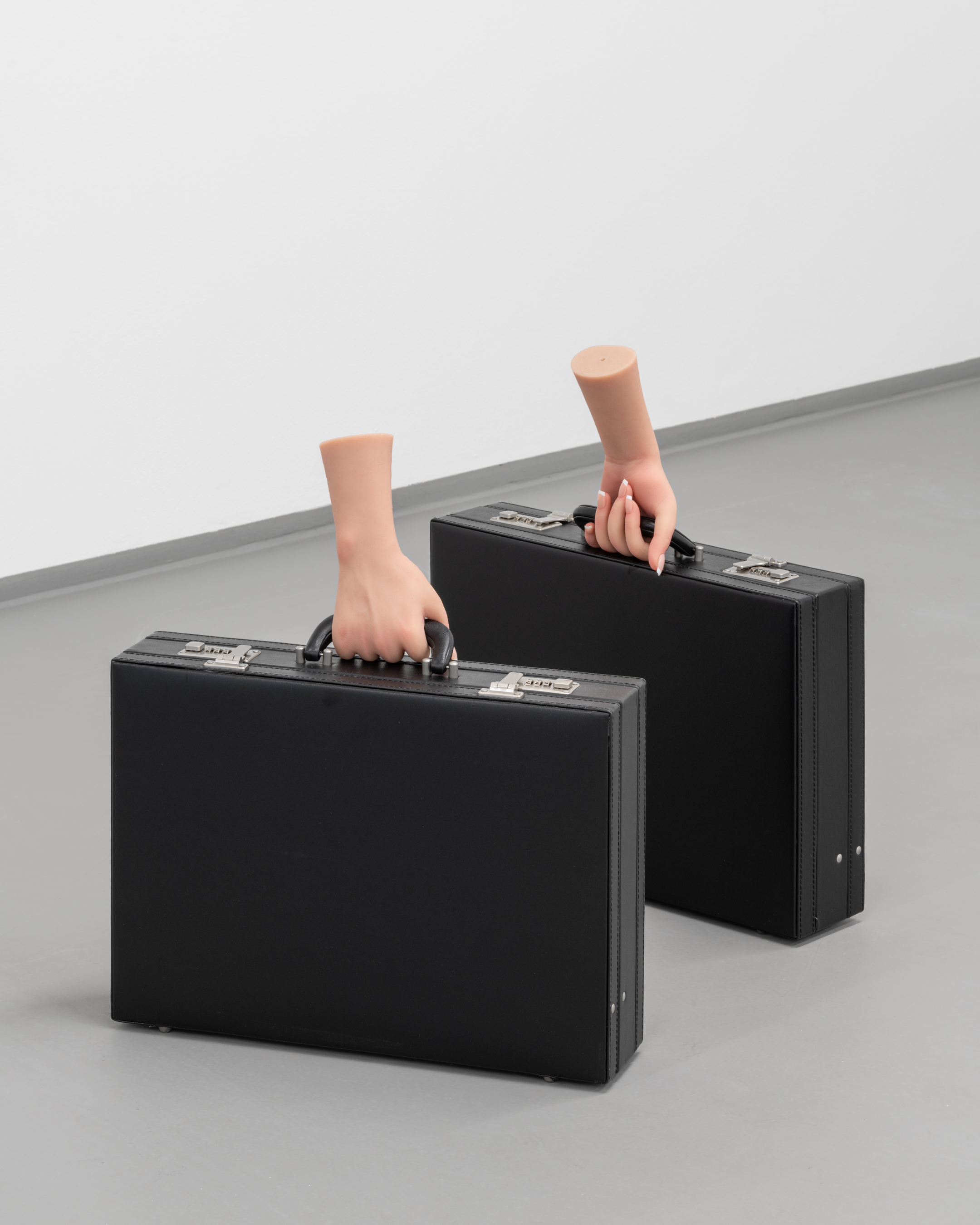
’Ding-dong-daddy’ - Sculpture; silicone hands and briefcases
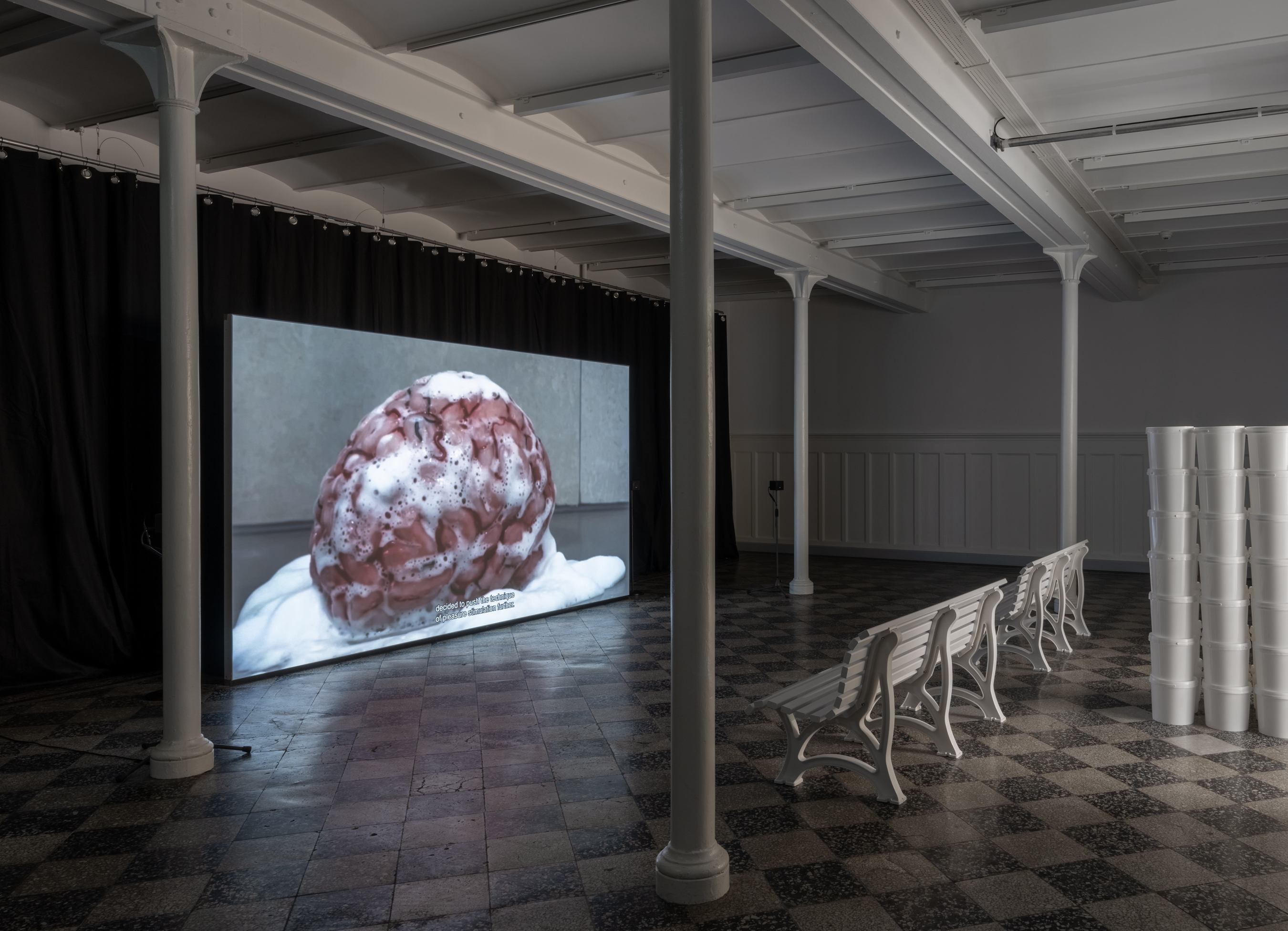
’Degenerative Knowledge Production’ - Documentary






Exhibition text:
“In 2023, my mother convinced me that intelligence is a purely random, local interaction and that the scientific phenomenon simply does not exist.”
For O—Overgaden, Andersson uncovers stupidity and absurdity as inherent to the systemic, scientific understandings of the brain and body—via a sped-up, research-led story of moving images and sculptural gestures.
Andersson’s major new film piece, Degenerative Knowledge Production, centers on electricity’s use as a metaphor and means to optimize, control, and classify the human brain as dumb, intelligent, or dead. The 75-minute film brews together punkish grainy images found trawling YouTube, popular feature films, and old documentaries. Against this audiovisual setting, an AI voiceover recounts how the history of electric brain experiments supports what Andersson coins the “cogiocracy”—the hegemonic rule of both the cognitive and cogito (thinking) or, plainly, how today’s society could be said to be controlled not by the people’s democracy but by rulers of the mind: the cogiocracy.
From early 18th-century electrical experiments (notably, German scientist Johann Wilhelm Ritter, who induced sexual arousal by electrically wiring his genitals), Victorian electromedicine, and 19th-century electroshock therapy, through to today’s AI brain, Andersson paves an unorthodox and shocking route into how electricity has been a hit-or-miss tool in manipulating our understanding of the human mind. A case in point: Andersson’s film reveals how scientific and societal developments repeatedly turn out to be entirely dependent on flat-out stupid experiments; a trail of errors often ignored by the typical historical accounts.
If the “major history” of the systemic rule of the mind (the cogiocracy) is told in Andersson’s feature-length film, another film piece, Me, ordering a mind control spell off Etsy to be cast on myself, results from the “minor history” of Andersson purchasing an esoteric “personalized” video of a liberating mind spell in defiance of (cogiocratic) “mind control”. Equally defiant is a wall of buckets, creating an obstructive architecture formed by 1:1-scale replicas of the plastic containers in the world’s largest store of preserved brain samples, a Danish collection today located at the University of Southern Denmark (SDU) in Odense. From the wall of buckets, odd occasional hair growth is escaping the autopsied, archived systematization. Another absurdist sculptural series combines the morbid shapes of 17th-century “mortsafes”—iron structures to prevent grave robbers from stealing corpses for use in scientific experiments—and benign Scandinavian wood carvings used in children’s furniture. Meanwhile a slapstick sculpture of black attaché cases held by disembodied hands seems to testify to the disconnected nature of modern systemic, rationalized work.
Ripping apart rational or “clever” optimization in surrealist combinations of inherently foreign things, the exhibition jests with the ivory tower of knowledge production and its progression. It is an invitation to understanding intelligence and stupidity as codependent—calling for degenerative, erratic, humorous, flawed, creative, psychedelic, and stupid plasticity as a part of the human tissue.
Degenerative Knowledge Production was developed with Index - The Swedish Contemporary Art Foundation in Stockholm and Kunsthall Trondheim in Trondheim; and is presented thanks to the support of The Danish Arts Foundation, Louis-Hansen Foundation, Beckett Fonden, Dansk-Svensk samarbejde and Rådet for Visuel Kunst.
Degenerative Knowledge Production is curated by Vera Østrup and Rhea Dahl
“In 2023, my mother convinced me that intelligence is a purely random, local interaction and that the scientific phenomenon simply does not exist.”
For O—Overgaden, Andersson uncovers stupidity and absurdity as inherent to the systemic, scientific understandings of the brain and body—via a sped-up, research-led story of moving images and sculptural gestures.
Andersson’s major new film piece, Degenerative Knowledge Production, centers on electricity’s use as a metaphor and means to optimize, control, and classify the human brain as dumb, intelligent, or dead. The 75-minute film brews together punkish grainy images found trawling YouTube, popular feature films, and old documentaries. Against this audiovisual setting, an AI voiceover recounts how the history of electric brain experiments supports what Andersson coins the “cogiocracy”—the hegemonic rule of both the cognitive and cogito (thinking) or, plainly, how today’s society could be said to be controlled not by the people’s democracy but by rulers of the mind: the cogiocracy.
From early 18th-century electrical experiments (notably, German scientist Johann Wilhelm Ritter, who induced sexual arousal by electrically wiring his genitals), Victorian electromedicine, and 19th-century electroshock therapy, through to today’s AI brain, Andersson paves an unorthodox and shocking route into how electricity has been a hit-or-miss tool in manipulating our understanding of the human mind. A case in point: Andersson’s film reveals how scientific and societal developments repeatedly turn out to be entirely dependent on flat-out stupid experiments; a trail of errors often ignored by the typical historical accounts.
If the “major history” of the systemic rule of the mind (the cogiocracy) is told in Andersson’s feature-length film, another film piece, Me, ordering a mind control spell off Etsy to be cast on myself, results from the “minor history” of Andersson purchasing an esoteric “personalized” video of a liberating mind spell in defiance of (cogiocratic) “mind control”. Equally defiant is a wall of buckets, creating an obstructive architecture formed by 1:1-scale replicas of the plastic containers in the world’s largest store of preserved brain samples, a Danish collection today located at the University of Southern Denmark (SDU) in Odense. From the wall of buckets, odd occasional hair growth is escaping the autopsied, archived systematization. Another absurdist sculptural series combines the morbid shapes of 17th-century “mortsafes”—iron structures to prevent grave robbers from stealing corpses for use in scientific experiments—and benign Scandinavian wood carvings used in children’s furniture. Meanwhile a slapstick sculpture of black attaché cases held by disembodied hands seems to testify to the disconnected nature of modern systemic, rationalized work.
Ripping apart rational or “clever” optimization in surrealist combinations of inherently foreign things, the exhibition jests with the ivory tower of knowledge production and its progression. It is an invitation to understanding intelligence and stupidity as codependent—calling for degenerative, erratic, humorous, flawed, creative, psychedelic, and stupid plasticity as a part of the human tissue.
Degenerative Knowledge Production was developed with Index - The Swedish Contemporary Art Foundation in Stockholm and Kunsthall Trondheim in Trondheim; and is presented thanks to the support of The Danish Arts Foundation, Louis-Hansen Foundation, Beckett Fonden, Dansk-Svensk samarbejde and Rådet for Visuel Kunst.
Degenerative Knowledge Production is curated by Vera Østrup and Rhea Dahl